
The Importance of an Estate Plan
Like a retirement plan, an estate plan is an important tool for a person or family. A retirement plan organizes assets during one’s lifetime, and the estate plan provides instructions for when you become incapacitated or have passed away.
An estate plan should help reduce the administrative burden for giving assets to your heirs, minimize the government’s involvement, and may reduce taxes. Even more importantly, it can protect the people you love from some of the stress and conflict that happens when no plan is in place.
Your estate plan will clarify your financial and medical wishes. It will also grant authority to people you trust to communicate these wishes if you are unable to do so. The next two sections will provide a high-level overview of the largest elements of your estate plan, which are your financial and medical wishes.
Continue reading below for more education, or proceed to Financial Wishes, Medical Wishes, or begin drafting your documents at any time.
Understanding Estate Documents
An estate plan can sound confusing, but if you break it down into smaller ideas it is easier to understand. Estate planning falls into two major categories: financial wishes and medical wishes. In addition, an estate plan answers this major question, “Who has the authority to carry out those wishes?”
Your estate plan should clearly communicate your financial and medical decisions and grant someone authority to assist with each area. This is typically done with four common documents, and they are named differently from state to state.
Review the graphic below. This shows the four common documents represented by four white boxes. The two white boxes on the left represent the documents that communicate your financial and medical wishes. The two white boxes on the right represent documents that grant authority for someone to act on your behalf to fulfill those wishes. Completing these documents and putting them into one large batch is the making of an “estate plan.”
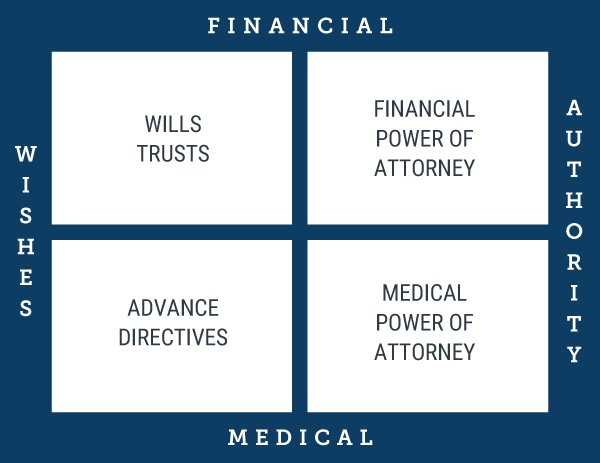
Here is a simple definition for each white box, representing common documents found in an estate plan.
Financial Wishes
Wills and Trusts
A Will or Trust communicates a person’s financial wishes.
Financial Authority
Financial Power of Attorney
The Financial Power of Attorney grants a person financial authority.
Medical Wishes
Advance Directives
Advance Directives communicate a person’s medical wishes.
Medical Authority
Medical Power of Attorney
Medical Power of Attorney grants a person medical authority.
Our goal with this estate planning overview is to build your understanding with helpful education. Continue to learn more about Financial Wishes or Medical Wishes. Or you can proceed with drafting your documents at any time.