
Financial Wishes
An estate plan will help your loved ones manage your assets if you are incapacitated, and should reduce the administrative burden of giving those assets to your heirs when you pass. This is done with specific documents, usually consisting of a will or trust, and coupled with a financial power of attorney that grants others permission to act on your behalf.
A will is a legal document that specifies the asset distribution upon your passing. A trust is a legal arrangement that transfers assets by the authority of a trustee. A trustee is an individual or institution that executes the specific directions of the trust. Completing your will or establishing a trust ahead of time is so helpful for you and your loved ones.
Using our educational graphic below, look at the box titled Wills and Trusts. You will see how it is closest to the words Financial Wishes. These documents outline a person’s financial wishes.
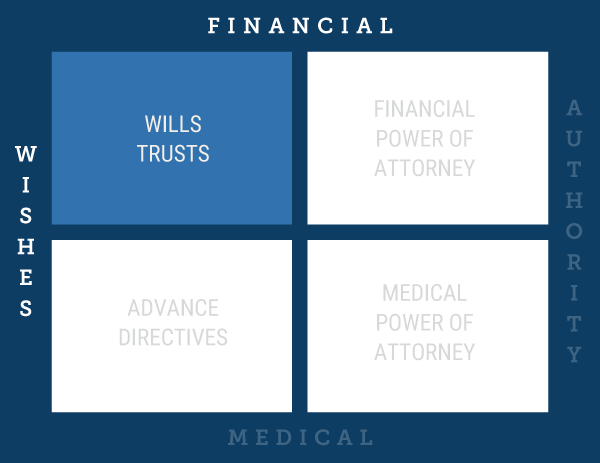
Some examples of financial wishes to consider may be as follows:
If I become incapacitated, who can help carry out my financial wishes?
When I pass, who will inherit the various portions of my estate?
If I want to give some assets to charity, how do I go about this?
How do others process my financial wishes in a timely manner?
How do I protect assets from people with ill intentions?
How do I keep assets from going to the government?
For more education, continue reading below. Or proceed to medical wishes, or begin drafting your documents at any time.
Differences Between a Will and a Trust
A will is a legal document that directs how your property will be distributed after your death. It specifically defines who will inherit your assets and can designate guardians for minor children. It will include the appointment of an executor (many times a close family member or an attorney), who is responsible for making sure your wishes are carried out as specified. A will does not take effect until after your passing. At that time it goes through probate, a court-supervised process of validating the will and distributing assets.
A trust is a legal arrangement where a trustee (person or institution) holds and manages assets for beneficiaries, based upon rules that are established in the trust. When a person has a unique need not met by a will, a trust may be the solution. It can take effect while you’re alive or after you have passed. A trust allows you to specify how and when assets are distributed to your beneficiaries (such as immediately, at certain ages, or in installments) and can also manage your assets if you become incapacitated. Some common scenarios that may require a trust would be owning property in more than one state, living in a state with burdensome probate laws, potential tax reduction, or to meet the needs of a special beneficiary plan.
Some people may use both a will to name guardians and accomplish other tasks, and a trust to manage assets and avoid probate. Review the Unique Situations page for additional ideas. When you begin drafting your documents, there will be more education provided along the way.
Financial Power of Attorney
A financial power of attorney is a legal document that allows someone to act on your behalf specifically regarding financial decisions. This person, often called an agent, will help handle your finances should you become incapacitated.
Selecting this person is one of the most important decisions you will make for your estate plan. When you draft your docuemnts, you will need to consider who to appoint for this role.
After selecting the right person, you can then decide what specific permission you want to give them. Common examples include filing your taxes, paying your bills, managing real estate, investing your money, and even running a business.
Back to our educational graphic, look at the Financial Power of Attorney box. You will see how it is closest to the words Financial and Authority. This document outlines who will have the authority for financial decisions in the event of your incapacitation.
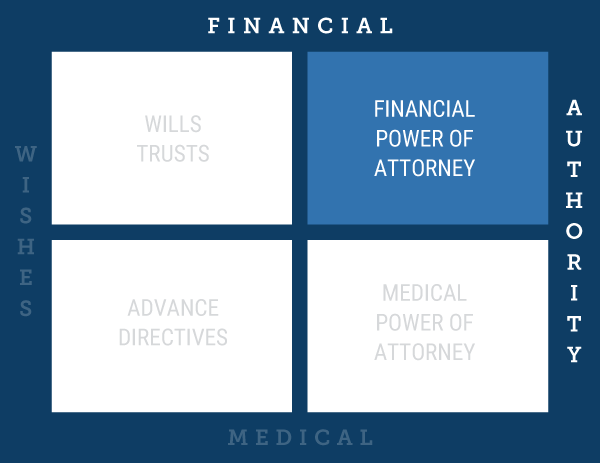
To continue to build your understanding, proceed to the Medical Wishes page below, or you can jump right into drafting your documents at any time.